
Inside the Delta Connection DL3543 Emergency Landing That Shook Passengers Mid-Air
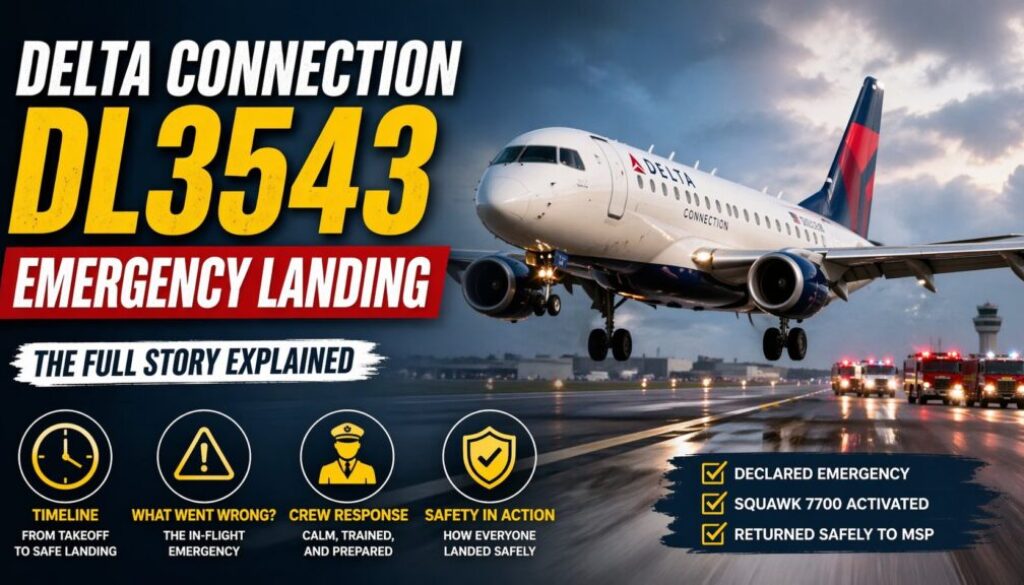
What Was Flight DL3543?
Delta Connection Flight DL3543 was a scheduled regional service operating between Minneapolis–Saint Paul International Airport (MSP) and Chicago Midway International Airport. It was a short domestic hop, the kind of flight millions of Americans take every week without a second thought.
The flight was operated by Endeavor Air, one of Delta Air Lines’ regional partners. Endeavor Air runs these shorter routes on behalf of Delta, using smaller aircraft suited for medium-density corridors. The plane assigned to this flight was an Embraer 170-200LR, a reliable twin-engine jet widely used across North America.
Passengers on board were expecting a smooth, roughly one-hour journey. The weather conditions were unremarkable, the crew had completed all standard pre-departure checks, and the aircraft lifted off from Runway 12R just after 1:00 PM UTC on July 7, 2025. Nothing about the departure suggested what was about to happen.
What Triggered the Emergency?
Approximately ten minutes after takeoff, while the Embraer 170-200LR was climbing through around 21,000 feet, the flight crew detected an abnormal condition on the flight deck. The exact technical nature of the issue was not publicly disclosed, which is standard practice while investigations are ongoing.
Pilots are trained to treat any unexplained or unexpected cockpit alert with the highest level of caution. Whether the warning involved a mechanical system, an electrical anomaly, or a pressure-related concern, the crew’s immediate response was to follow established emergency protocols rather than continue toward the destination.
In aviation, declaring an emergency is not a sign of failure. It is a deliberate, trained response designed to protect everyone on board before a situation has the chance to escalate.
The pilots activated Squawk 7700, the internationally recognized transponder code for in-flight distress. This signal immediately alerts air traffic control and grants the aircraft priority handling in the airspace, clearing a direct path back to the departure airport without delay.
How Did the Events Unfold?
The entire sequence from takeoff to safe landing unfolded in under 40 minutes, a remarkably swift response that reflects years of crew training and a well-coordinated aviation emergency system working exactly as designed.
The Embraer 170-200LR: The Plane Behind the Flight
The aircraft at the center of this incident, registered as N259SY, is an Embraer 170-200LR. This is a twin-engine regional jet manufactured by Brazilian aerospace company Embraer. It is a popular choice for short to medium-haul routes across North America, known for its reliability and passenger comfort.
The Embraer 170 series is equipped with modern avionics and multiple redundant safety systems. These systems are designed to detect and alert crews to potential issues well before they become critical, which is precisely what happened during flight DL3543. The aircraft’s onboard monitoring did its job.
After the emergency landing, the aircraft was immediately grounded and handed over to maintenance teams. Under Federal Aviation Administration regulations, any aircraft that has declared an emergency must undergo a thorough inspection before it is cleared to return to service. This process ensures that the root cause is fully identified and resolved.
How the Flight Crew Handled the Situation
One of the most important aspects of this incident is the crew’s response. The pilots followed a structured decision-making process, using checklists and coordinating with air traffic control at every stage. Their priority was clear: get the aircraft and everyone on board safely back on the ground as quickly as possible.
Cabin crew played an equally important role. Passengers on board reported that announcements were clear, calm, and reassuring. The crew kept communication open without causing unnecessary alarm. This kind of composed professionalism is the result of hundreds of hours of simulator training specifically designed for emergency scenarios.
Key aspects of how the crew managed the situation:
- Immediate identification and assessment of the flight deck anomaly
- Activation of Squawk 7700 to notify air traffic control
- Coordinated turn-back toward Minneapolis with ATC guidance
- Cabin preparation and clear passenger communication
- Smooth, controlled descent and landing on Runway 12R
The outcome, a safe landing with zero injuries, is a direct reflection of that training. This is exactly the kind of event aviation authorities point to when discussing why rigorous pilot training standards exist.
What This Means for Aviation Safety
Declared in-flight emergencies happen more often than most passengers realize. The FAA processes thousands of them each year across commercial aviation in the United States. The vast majority end exactly like DL3543: safely, professionally, and without injury. These declarations are a feature of the system, not a flaw.
Commercial aviation remains one of the statistically safest modes of transportation on earth. The layered safety systems built into modern aircraft, combined with extensive pilot training and rigorous air traffic control procedures, mean that even when something goes wrong, the outcome is usually a safe, controlled resolution on the ground.
The Delta Connection DL3543 incident is a strong example of this. The crew did not wait to see if things would get worse. They made the safe call quickly, and the system supported them every step of the way. That is how aviation is supposed to work, and in this case, it worked perfectly.
What Passengers Went Through
For the passengers on board, the experience was unexpected and understandably unsettling. What should have been a routine one-hour flight suddenly became something very different. Cabin crew made announcements, the aircraft turned around, and the mood in the cabin shifted noticeably.
Despite the stress of the moment, passengers reported that the crew handled things calmly and professionally. Many noted that the landing itself felt smooth and controlled, with no rough contact or abrupt maneuvering. Emergency vehicles were visible on the ground as the aircraft rolled to a stop, which some passengers found alarming but which is a completely standard precaution.
After deplaning, Delta Air Lines staff worked to rebook affected passengers and provide support. For travelers with connecting flights, the delay caused a cascade of changes, but the airline’s ground teams managed the disruption. No physical injuries were reported among passengers or crew, and that remains the most important outcome of the entire incident.
Frequently Asked Questions (FAQs)
What caused the Delta Connection DL3543 emergency landing?
The specific technical cause was not officially disclosed to the public, as is standard practice during ongoing aviation investigations. The crew detected an abnormal condition during climb at approximately 21,000 feet and made the professional decision to return to Minneapolis rather than continue. Aviation safety protocols require crews to act on any unexplained alert, and that is exactly what happened here.
Was anyone injured during the DL3543 emergency landing?
No. All passengers and crew on board Flight DL3543 deplaned safely without any reported injuries. The landing was smooth and controlled, and emergency services on the ground were present as a precautionary measure. The absence of injuries is a direct result of how quickly and professionally the crew responded to the situation.
What does Squawk 7700 mean?
Squawk 7700 is a transponder code used by pilots to declare a general in-flight emergency. When a pilot activates this code, it immediately signals air traffic control that the aircraft requires priority handling. ATC then clears the airspace around the aircraft and coordinates a direct route to the nearest suitable airport. It is a standard tool used in aviation emergencies worldwide.
How long did the whole emergency last from takeoff to landing?
The entire sequence lasted approximately 37 minutes. The aircraft departed Minneapolis at 13:09 UTC and touched down safely back on Runway 12R at around 13:46 UTC. This rapid response time reflects the efficiency of the crew’s decision-making and the coordination between the flight deck and air traffic control.
What type of aircraft was used on Flight DL3543?
Flight DL3543 was operated using an Embraer 170-200LR, registered as N259SY, and operated by Endeavor Air on behalf of Delta Air Lines. The Embraer 170 is a twin-engine regional jet widely used across North American short-haul routes. It is equipped with modern avionics and multiple safety monitoring systems.
Should passengers be worried about flying Delta Connection routes after this incident?
There is no reason for concern. The DL3543 incident actually demonstrates how well aviation safety systems function. The crew identified a potential issue, responded correctly, and landed safely. Commercial aviation is one of the safest forms of transportation, and declared emergencies that end safely are evidence of a well-designed system working as intended, not a reason to avoid flying.
A Story About Safety Working Exactly Right
The Delta Connection DL3543 emergency landing was not a tragedy. It was a demonstration of aviation safety systems, professional crew training, and coordinated ground response all working together seamlessly. Every person on board arrived safely, and that is the only outcome that truly matters.