
Safe Trails Task Force Fremont County: Everything You Need to Know
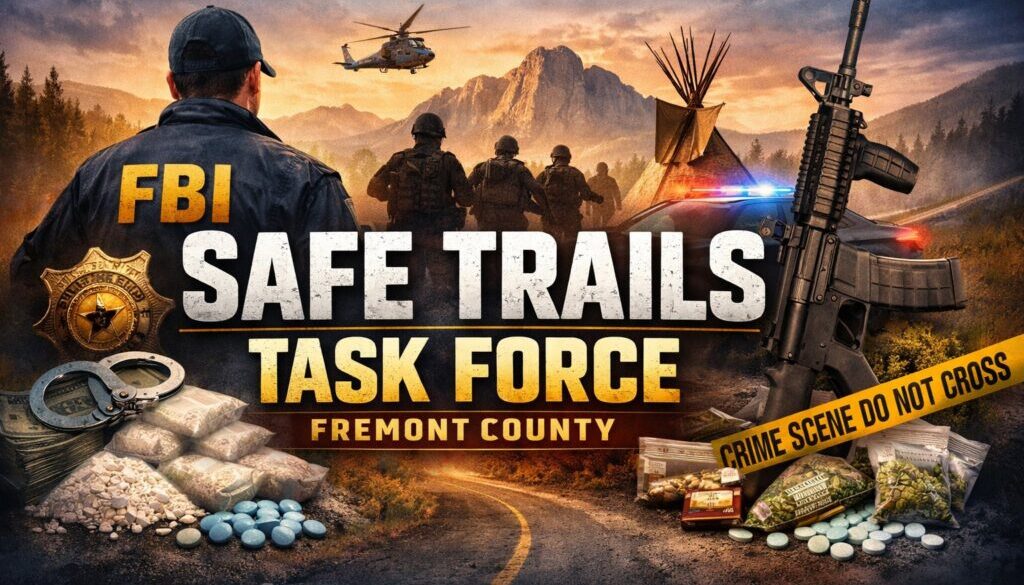
Fremont County, Wyoming, is a place of wide open land, tight-knit communities, and deep tribal roots. But beneath that peaceful surface, a serious challenge has been growing for years. Drug trafficking, illegal firearms, and violent crime have pushed families and local leaders to demand a stronger, more coordinated response. That response came in the form of the Safe Trails Task Force.
The Safe Trails Task Force operating in Fremont County is not a brand-new idea. It is part of a larger national FBI model known as the Rocky Mountain Safe Trails Task Force (RMSTTF). This initiative was built specifically to address crime in rural areas and tribal lands, where single agencies often lack the reach or resources to act alone. In Fremont County, it has become one of the most active law enforcement collaborations in the region.
What Is the Safe Trails Task Force?
The Safe Trails Task Force is a multi-agency law enforcement coalition led by the Federal Bureau of Investigation. It was created to tackle serious crimes that cross jurisdictional lines, particularly in areas involving tribal communities. The task force brings together federal, state, local, and tribal partners under one shared mission.
What makes this model effective is its structure. No single agency carries the full weight. Instead, each partner contributes resources, intelligence, and manpower. This approach allows investigators to respond faster, pursue wider networks, and secure stronger cases in court.
Why Fremont County?
Fremont County sits in central Wyoming and is home to the Wind River Indian Reservation, one of the largest reservations in the United States. The reservation is home to both the Eastern Shoshone and Northern Arapaho tribes. This unique geography creates overlapping jurisdictions that can complicate standard law enforcement responses.
Criminal networks have taken advantage of this complexity for years. Drug suppliers from larger cities like Denver and Las Vegas identified Fremont County as a target area, using local contacts to distribute methamphetamine, fentanyl, cocaine, and other controlled substances. The Safe Trails Task Force was established partly to dismantle those networks directly.
The rural nature of the county also plays a role. Remote roads, limited surveillance infrastructure, and long distances between towns make tracking criminal activity more difficult. A coordinated task force model addresses these gaps more effectively than any single department could on its own.
Who Are the Member Agencies?
The task force includes a wide range of partners that each bring unique capabilities to operations. The core members active in Fremont County include:
- The Federal Bureau of Investigation (FBI)
- The Drug Enforcement Administration (DEA)
- The Wyoming Division of Criminal Investigation (DCI)
- The Wyoming Highway Patrol
- The Fremont County Sheriff’s Office
- The Riverton Police Department
- The Lander Police Department
- The Bureau of Indian Affairs (BIA) Wind River Police Department
Each agency plays a defined role. The FBI provides federal investigative authority and coordinates major operations. Local departments contribute community knowledge and on-the-ground presence. Tribal law enforcement ensures that cases affecting reservation residents are handled with proper jurisdiction and cultural awareness.
What Does the Task Force Actually Do?
The task force focuses on several core activities that directly impact community safety. Drug interdiction is the most visible area of work. Investigators target supply chains bringing methamphetamine and fentanyl into the county, building cases that result in federal charges and significant prison sentences.
Illegal firearms removal is another critical priority. Guns tied to drug trafficking crimes compound the risk of violence in communities. By seizing weapons alongside drug evidence, the task force disrupts the tools that make criminal networks more dangerous.
The task force also conducts warrant operations that can involve large numbers of personnel. In one notable operation, more than 90 FBI personnel were deployed across the Wind River Reservation, resulting in multiple federal search warrants executed within a 48-hour window. These coordinated sweeps are designed to dismantle networks quickly before members can alert each other.
Beyond enforcement, the task force supports victim assistance and community safety programs. Law enforcement leaders have acknowledged publicly that many individuals caught in drug networks were themselves first victimized by addiction. This understanding shapes how investigators approach casework and community engagement.
Key Cases and Real Outcomes
The task force has produced significant results in recent years. In one case, a Lander man was arrested after investigators seized more than 500 grams of methamphetamine, over 32 grams of fentanyl, and 14 firearms from his residence. He faced federal charges carrying a potential sentence of 10 years to life.
In another case, two individuals were convicted after bringing large quantities of methamphetamine from Denver into Fremont County. At the time of arrest, investigators also recovered five illegal firearms and cocaine. These cases illustrate how drug trafficking and illegal gun possession often go hand in hand.
A separate investigation targeted two women who transported six pounds of methamphetamine from Las Vegas to Fremont County. Both were sentenced after a sustained undercover operation. These cases reflect how trafficking networks often rely on local participants who become embedded within communities, making long-term investigative work essential.
The Fentanyl Problem in Fremont County
Fentanyl has become the dominant concern driving task force operations in recent years. It is far more potent than heroin and far cheaper to produce, which makes it attractive to trafficking networks looking to maximize profit margins. Even small quantities can cause fatal overdoses.
The presence of fentanyl in Fremont County has led to a spike in overdose deaths that has shaken families throughout the region. The task force responded by designating the area as a priority zone and dedicating investigative resources to mapping how fentanyl enters and moves through the local supply chain.
Investigators note that fentanyl distribution in Fremont County is not random. It follows structured networks with identifiable roles. Disrupting even one tier of that structure, whether a supplier, a distributor, or a local dealer, can interrupt the flow of the drug for a meaningful period and save lives in the process.
Community Impact and Public Safety
The results of task force operations extend far beyond individual arrests. Each conviction represents a broken link in a supply chain that was actively harming the community. Families living near active drug distribution points have reported feeling safer after major enforcement actions.
Public officials have been vocal about the task force’s role in addressing what they describe as a cycle of violence tied to drug activity. Homicides, assaults, and overdoses in Fremont County have all been linked to drug trafficking at various points, and the task force has worked to interrupt those connections through sustained investigation and prosecution.
Community trust is something the task force actively works to maintain. Law enforcement leaders have held press conferences, answered public questions, and clarified the nature of operations when rumors spread on social media. That transparency matters in a county where communities have complex historical relationships with federal authorities.
Challenges the Task Force Faces
Operating in Fremont County is not without difficulty. The geographic size of the area, combined with limited road infrastructure in certain parts of the reservation, makes rapid response challenging. Criminal networks are also highly adaptive, shifting methods and contacts when they sense law enforcement pressure.
Building trust with tribal communities requires consistent, respectful engagement over time. Historical tensions between federal agencies and Indigenous communities do not disappear overnight. The task force has worked to position itself as a protector of those communities rather than an outside force acting upon them.
Resource limitations also present ongoing challenges. Sustained investigation requires personnel, surveillance tools, and prosecutorial capacity. The task force model helps pool those resources, but the demand in Fremont County consistently outpaces what is available at any given time.
Frequently Asked Questions (FAQs)
What is the Safe Trails Task Force in Fremont County?
It is a multi-agency law enforcement collaboration led by the FBI that focuses on combating drug trafficking, violent crime, and illegal firearms in Fremont County and the Wind River Indian Reservation area.
Which agencies are part of the task force?
The task force includes the FBI, DEA, Wyoming Division of Criminal Investigation, Wyoming Highway Patrol, Fremont County Sheriff’s Office, Riverton Police Department, Lander Police Department, and tribal law enforcement.
Why is the Wind River Reservation a focus area?
The reservation involves overlapping federal, state, and tribal jurisdictions. Criminal networks have historically exploited this complexity to distribute drugs and evade accountability, making coordinated enforcement especially important there.
What drugs does the task force primarily target?
Methamphetamine and fentanyl are the primary focus, though investigations also address cocaine and other controlled substances being trafficked into the county from larger cities.
How does the task force impact the local community?
By dismantling supply chains and removing illegal firearms, the task force reduces drug-related violence and overdose deaths. Communities experience safer neighborhoods and greater confidence in law enforcement over time.
Can residents report criminal activity to the task force?
Yes. Residents with information about drug trafficking or violent crime can contact local law enforcement agencies that are task force members, including the Fremont County Sheriff’s Office or the Riverton Police Department.
Final Thoughts
The Safe Trails Task Force in Fremont County represents what coordinated law enforcement can look like when agencies put aside territorial boundaries and work toward a single goal. The problems facing this region, particularly drug trafficking and its violent ripple effects, are serious and deeply rooted. They will not disappear after one operation or one round of arrests.
What the task force offers is consistency. It is a long-term commitment by multiple agencies to keep showing up, keep building cases, and keep making the county safer one investigation at a time. For the families living in Fremont County and on the Wind River Reservation, that consistency is not just reassuring. It is essential.